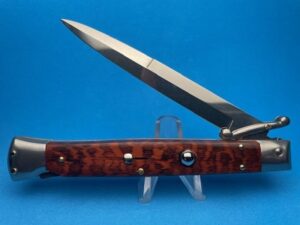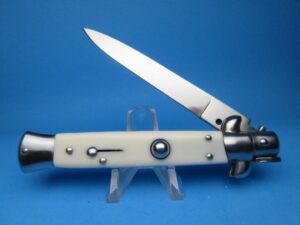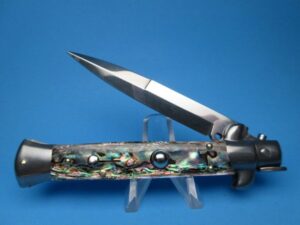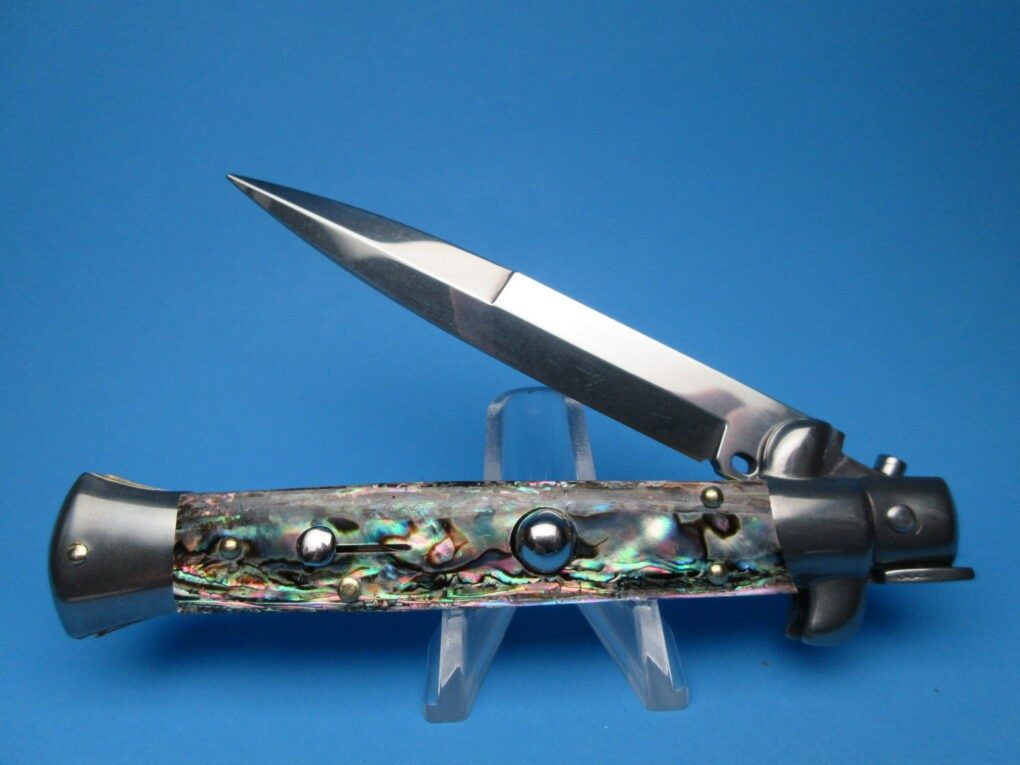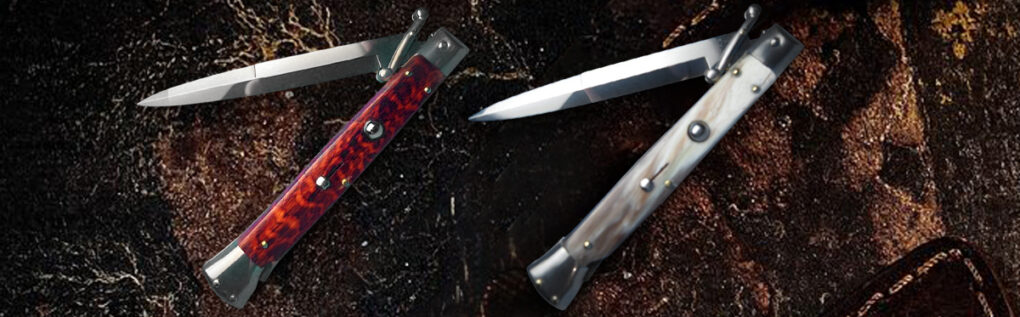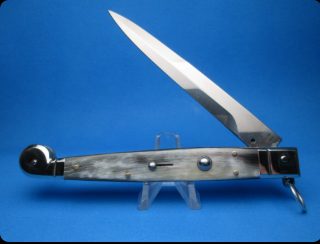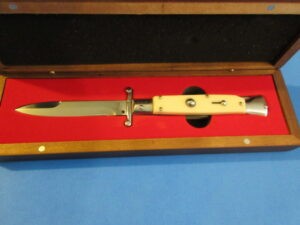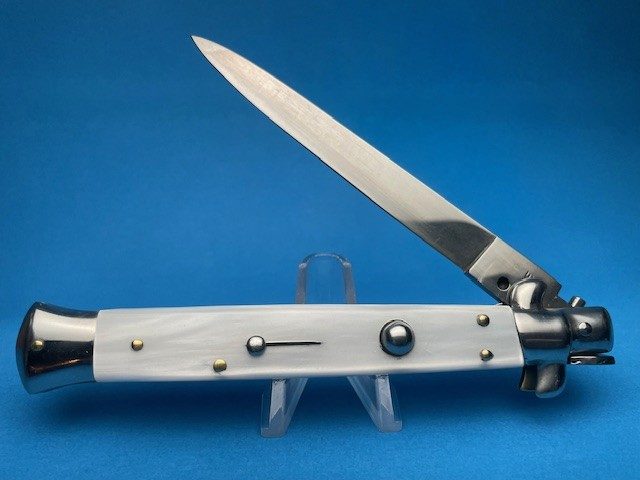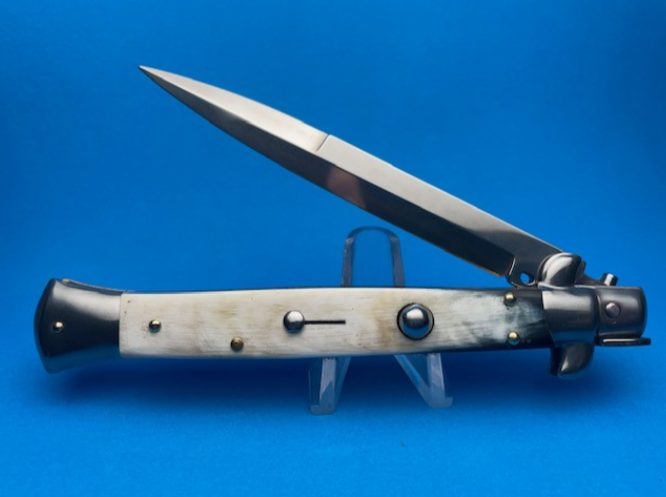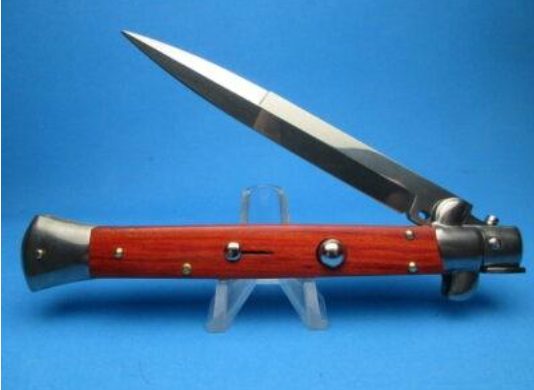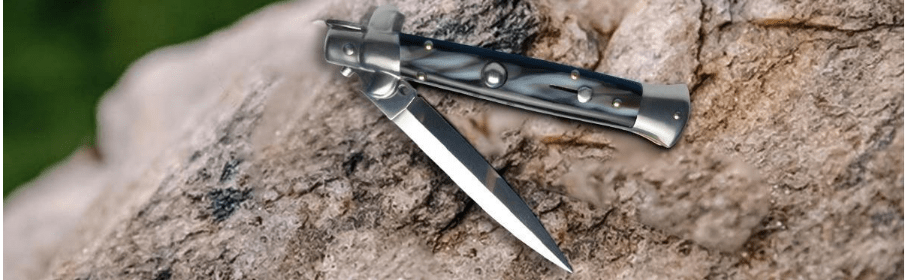
Few blades evoke as much fascination among knife enthusiasts, design aficionados, and collectors as the swing guard stiletto knife. Elegant, sleek, and mechanically unique, this swing guard stiletto is more than a knife. It represents creativity, craftsmanship, and long-lasting design.
But exactly what turned the folding knife into a “timeless classic”? To understand the enduring appeal of the swing guard, we have to look beyond the steel and ivory. We have to dive into the history, the scenarios, and the unique mechanical dance that happens every time the blade is deployed
The Mechanical Ballet: How the “Swing” Matters
What sets a swing guard stiletto knife apart is its pivoting hilt. Unlike a fixed-guard knife, the cross-guard of this model is in line with the handle when closed. When the button is pushed, and the blade snaps open with that characteristic Italian thwack, those guards swing upward, becoming perpendicular to the blade.
This isn’t just for show. In a historical use-case scenario, the swing guard solved a major problem for the 20th-century gentleman. A standard fixed-guard stiletto, while beautiful, was notorious for snagging on pocket linings or waistcoats. The swing guard offered a “low-profile” carry; it provided the safety of a cross-guard (preventing the hand from sliding onto the sharp edge during use) without the bulk of a permanent protrusion. It was the ultimate “sleek” solution for a high-stakes environment.
A Legacy Born in Maniago
To talk about the swing guard is to talk about Maniago, Italy. This small town at the foot of the Alps has been home to Italian blade-smithing for centuries. Italian craftsmen worked in the post WW2 period on improving this switchblade for an international market.
The swing guard stiletto knife emerged as a luxury tier of these offerings. It needs more moving parts, tighter tolerances, and requires a greater amount of hand-fitting than the standard bolster-lock. When you get your hands on a swing guard from a legacy maker, AGA Campolin or Frank Beltrame, you are not just holding a tool. You are holding a piece of kinetic art that has been refined over generations.
Modern Use-Cases: Why We Collect Them Today
In 2026, the use case of a swing guard stiletto has shifted from the street-side defense in the 1950s to the gentleman’s collection of today. Here is why they remain essential.
1. The Ultimate Conversation Piece
Pulling out a swing guard stiletto knife to open a package or a letter is an instant icebreaker. Here, the mechanical complexity of the guards never fails to fascinate.
2. Tactile Satisfaction
For the “fidget” enthusiast or the mechanical hobbyist, the deployment of a swing guard is incredibly satisfying. The weight of the guards swinging into place adds a unique vibration and sound that a standard folder simply cannot replicate.
3. Heirloom Investment
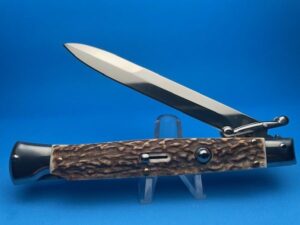
High-quality Italian swing guards are often produced in limited runs. With materials like genuine Brazilian horn, stag, or abalone handles, these knives appreciate in value as they become harder to find.
Conclusion: The “Timeless” Factor
The swing guard stiletto knife is a classic because it refuses to be boring. It represents a time when tools were expected to have personality. It fills the gap between a tool and a piece of jewelry.
Whether it is the 11-inch “Big Boy” models that command attention or the smaller 9-inch variants that disappear into a pocket, the swing guard remains the gold standard for those who appreciate Italian flair. It’s a blade that has history the moment it clicks into place.
Watch out for dozens of offerings in the Italian swing guard stiletto knife category at MySwitchBlade. We have them from classic heritage to modern concepts, all carefully handpicked and tested for quality and collectors’ worthiness.
Your Questions Answered
1. What is the main purpose of the “swinging” guard?
The primary purpose is twofold: Portability and Safety. The guard is meant to compress when the knife is closed, so that it does not snag on your pocket. When opened, the guard secures itself solely behind the knife blade to reduce interference while you work.
2. Is a swing guard stiletto knife more fragile than a regular stiletto?
Because it has more moving parts (pivots and pins for the guards), it requires slightly more maintenance. While not “fragile,” it is designed more as a precision collector’s item or a light-duty tool rather than a heavy-duty camping knife. Keeping the pivot oiled is key.
3. What materials are best for the handle (scales)?
For a classic look, Brazilian Horn or Genuine Stag are the best ones among collectors because every piece is unique. For everyday carry or durability options, Acrylic or G-10 scales offer great resilience against the elements.
4. Are swing guard stilettos purely for collectors?
Not necessarly. While many enthusiasts collect them for historical and design reasons, they can also serve as functional carry pieces. This is for those who appreciate its balance of utility and form.
5. How should I care for my swing guard stiletto knife bought from MySwitchBlade?
With the right amount of regular cleaning, light lubrication on all movable parts, and storing it in a dry place away from moisture, it helps maintain its smooth operation and prevent corrosion.